What happens when the car itself becomes the key witness in a crash investigation?
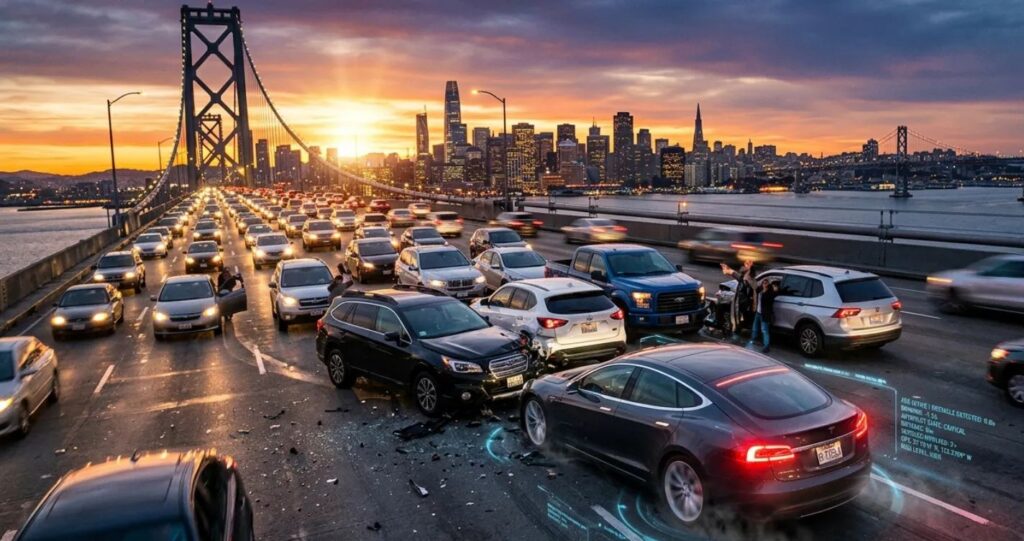
On Thanksgiving Day 2022, a single software decision inside a Tesla Model S triggered an eight-car pileup on the San Francisco Bay Bridge, raising urgent questions about liability, insurance, and the limits of autonomous driving technology.
Introduction
This incident was more than a traffic accident. It became a defining case in the growing tension between driver responsibility and software-controlled vehicle systems.
For insurers, lawyers, and regulators, the crash represented a new era where digital evidence could outweigh human testimony.
Quick Facts
- Date: November 24, 2022 (Thanksgiving Day)
- Location: San Francisco Bay Bridge
- Vehicle: Tesla Model S
- System: Full Self-Driving (FSD) Beta
- Crash: 8 vehicles involved
- Injuries: 9 people
- Main issue: Phantom braking and liability
The Real Story
On Thanksgiving morning in 2022, a Tesla Model S was crossing the San Francisco Bay Bridge with the Full Self-Driving (FSD) beta system activated.
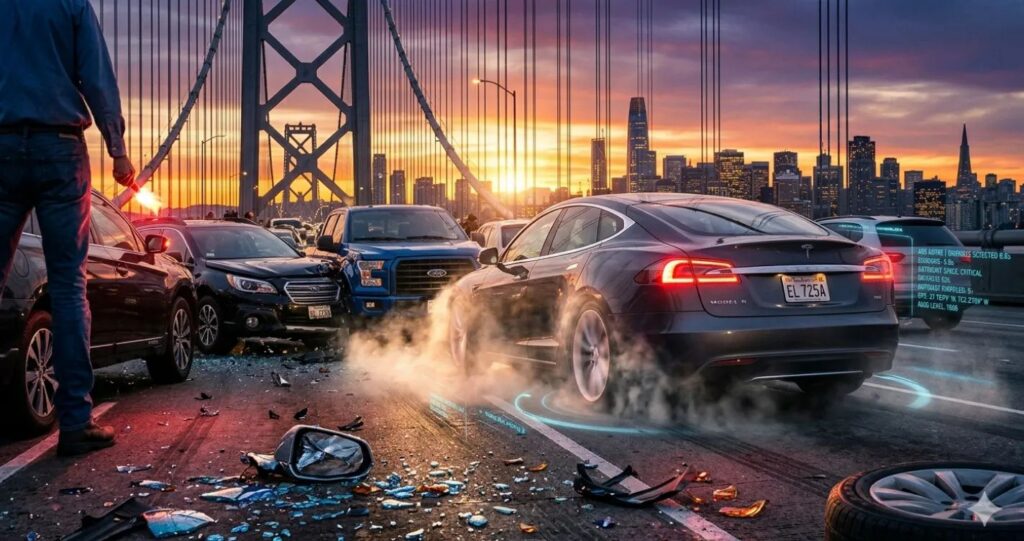
Without warning, the vehicle suddenly changed lanes and applied heavy braking in a fast-moving traffic lane.
According to the official crash reconstruction and California Highway Patrol footage, the vehicle slowed sharply, causing a chain-reaction collision involving eight vehicles.
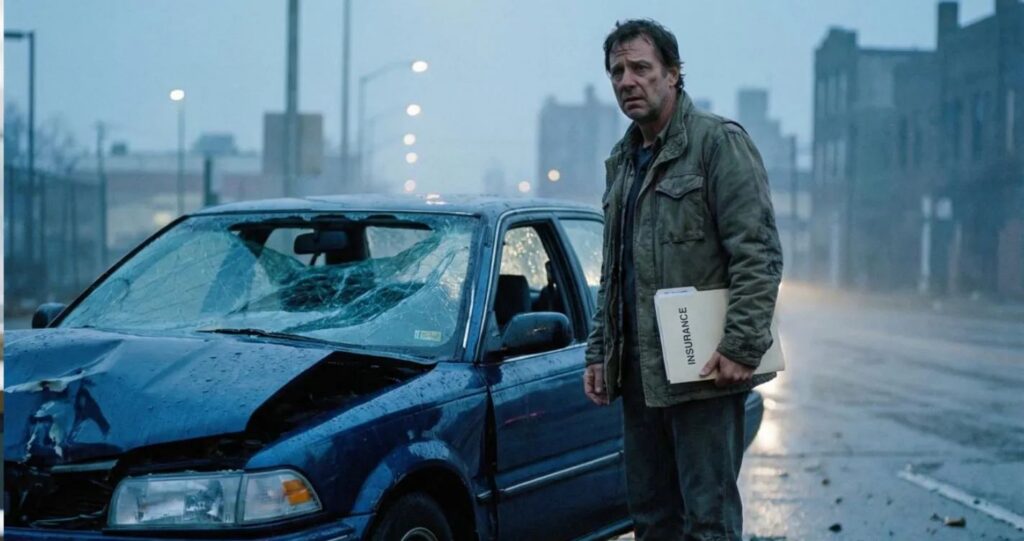
Nine people were injured in the crash, including minors. The accident quickly became a national story because the driver claimed the braking was triggered by the FSD software itself.
Investigative Analysis
Page 1: The Technological Shock
This was not a traditional accident caused by fatigue, distraction, or speeding.
The critical issue was a software decision—what Tesla drivers often call phantom braking.
From an insurance perspective, this shifts the cause of loss from “human error” to “algorithmic behavior.”
The event exposed the friction between marketing language such as “Full Self-Driving” and the legal reality that the system remains driver-supervised.
Page 2: The Digital Witness
Unlike traditional claims that rely on conflicting driver statements, this case was reconstructed using telematics and onboard event data.
The vehicle’s data logs confirmed that FSD was active at the time of the crash. This made the car itself the most objective witness in the case.
Insurance companies increasingly treat this type of digital evidence as the new standard for liability investigations.
Page 3: The Liability Dilemma
This created a legal paradox:
- Was the driver negligent for failing to intervene?
- Or did the software create the dangerous condition?
This is where insurance law is rapidly evolving—from covering only driver negligence to potentially covering software-induced hazards.
Legal Insight
The key legal principle remains the Hands-on-Wheel Doctrine.
Under current U.S. law, driver-assistance technology does not remove legal responsibility from the human operator.
Courts and insurers still view the driver as the active supervisor of the system, not as a passive passenger.
This allows insurers to raise premiums based not only on crash history but also on behavioral risk metrics such as delayed intervention and attention scores.
How the Insurance System Works (Tesla Model)
Tesla Insurance operates using Usage-Based Insurance (UBI), a model fundamentally different from traditional pricing.
- Safety Score: real-time monitoring of harsh braking, sharp turns, and following distance
- Dynamic Pricing: next month’s premium adjusts automatically based on this month’s driving behavior
- Reduced Human Bias: pricing relies more on driving data than age or demographic assumptions
This system turns driving behavior into a live pricing model.
Key Lesson
In modern insurance, data is becoming more powerful than testimony.
The future of claims handling is increasingly driven by telemetry, software logs, and digital reconstruction.
Lessons Learned
- Driver-assistance systems do not remove liability
- Vehicle data can determine claim outcomes
- Software defects may create new insurance risks
- High-tech vehicles often carry higher premiums
Practical Advice
- Never assume FSD replaces driver attention
- Review your policy’s liability and collision terms
- Understand how telematics impacts premiums
- Keep all software update and vehicle service records
FAQ
Q: What is phantom braking?
A: Sudden automatic braking without an actual obstacle.
Q: Who is liable in an FSD crash?
A: Under current law, the driver usually remains primarily responsible.
Q: Can insurers use Tesla data in claims?
A: Yes, telematics and event logs are increasingly central to accident reconstruction.
Conclusion
This case marked a turning point in how insurance companies, courts, and regulators think about vehicle accidents.
As vehicles become more software-driven, the central legal question is no longer just “Who was driving?” but increasingly “What did the system decide?”
Sources
- [CBS News]: Driver claims Tesla self-driving software triggered Bay Bridge crash
- [KTVU Fox 2]: Surveillance video shows moment Tesla brakes on Bay Bridge before pileup
- [National Highway Traffic Safety Administration]: Automated Vehicles Safety & Investigations
- [The New York Times]: Tesla Full Self-Driving and crash investigations
Author
Written by Hicham