

When Glitz Becomes a Trap: The Kim Kardashian Jewelry Heist and the Hard Lessons of Celebrity Travel Insurance
The Kim Kardashian jewelry heist in Paris was more than just a shocking celebrity crime; it triggered one of the most complex insurance claim investigation process cases in recent history, forever changing how high-value assets are protected abroad.
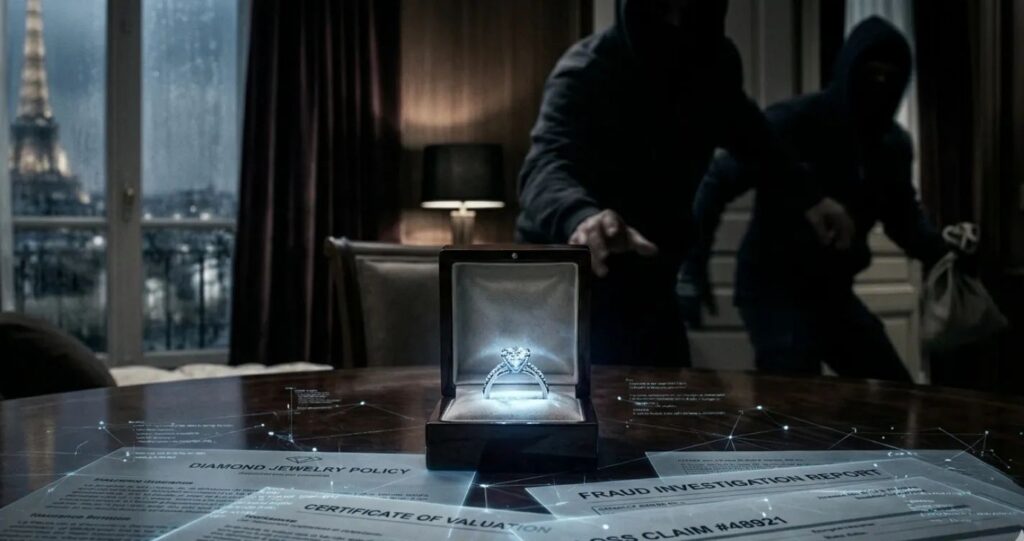
On a cold October night in 2016, inside a luxury Parisian hotel, Kim Kardashian became the target of a meticulously planned $10 million robbery. Five men disguised as police officers, a silent room, and a crime that would ripple far beyond Paris.
What followed wasn’t just a criminal investigation—it was a high-stakes test of travel insurance for luxury items, policy limits, and the hidden clauses behind jewelry insurance coverage in the USA.
Dissecting the Incident
From a journalistic standpoint, the key question wasn’t who stole the jewelry—but whether the risk was preventable under insurance terms.
Social Media Exposure
Kardashian’s real-time sharing of her location and assets created what insurers define as a “Voluntary Increase of Risk,” a factor that can influence the insurance claim investigation process .
The AIG Legal Strategy
According to Reuters , AIG pursued legal action after settling the claim, shifting the focus from theft to liability.
The issue was not whether the robbery happened, but whether negligence affected coverage.
Insurance Expert Insight: The Hidden Clause That Matters
Most high-value insurance disputes stem from breach of contract conditions rather than fraud.
- Warranted Security Clause
- Mandatory protection requirements
- Violation leads to reduced or denied payout
Investigators found that the absence of the primary bodyguard may have violated agreed security protocols.
How High-Value Travel Insurance Actually Works
Standard Coverage
Basic travel insurance policies usually cap valuable items between $500 and $1,500.
High-Value Item Coverage
According to the Insurance Information Institute , expensive items require scheduled personal property coverage, including appraisal and documentation.
Pricing Logic
Premiums are calculated based on:
- Risk exposure
- Security measures
- Behavioral patterns
Why Insurance Claims Get Reduced or Denied
- Breach of policy conditions
- Contributory negligence
- Incomplete documentation
- Digital footprint evidence
Psychological & Technical Dimensions
The Kardashian case serves as a landmark study in behavioral economics and the concept of moral hazard within the insurance industry. Psychologically, having high-value coverage can sometimes lead to a "security paradox," where insured individuals may inadvertently lower their guard, assuming the financial safety net is absolute. However, modern insurers are shifting their focus from static risk to dynamic behavior tracking.
Technically, the industry has evolved significantly since 2016. Insurance investigators now utilize advanced data analytics and AI-driven tools to monitor digital footprints in real-time. This means that an influencer’s social media activity is no longer just a marketing tool; it is a critical data point in a "Real-Time Risk Assessment" model. If an insured party displays high-risk behavioral patterns—such as broadcasting the exact location of multi-million dollar assets to a public audience—insurers may use this digital evidence to argue that the policyholder failed their contractual duty to mitigate risk.
This level of scrutiny isn't reserved for celebrities; it is the same rigorous approach used in medical billing investigations to verify the authenticity of high-value claims and prevent financial fraud.
How the System Operates
Insurance contracts operate under the principle of utmost good faith, requiring full disclosure of risk.
After settling the claim, AIG exercised subrogation rights to recover losses from responsible third parties.
How This Case Changed Insurance Behavior
According to the National Association of Insurance Commissioners , modern underwriting increasingly considers behavioral risk factors.
- Stricter policy conditions for high-value clients
- Integration of social media risk assessment
- Enhanced investigation processes
FAQ
What is covered under travel insurance for expensive jewelry?
Standard policies do not cover high-value items. Specialized coverage is required.
Can insurance deny a claim due to social media activity?
Yes. If digital exposure increases risk, claims may be reduced or denied.
How do insurers investigate luxury theft claims?
They analyze digital behavior, claim patterns, and supporting documentation.
What are common reasons for claim denial?
Policy violations, missing documentation, and increased risk behavior.
Conclusion
This case demonstrates that insurance is not automatic protection but a conditional agreement based on behavior and risk management.
Sources


Pingback: Influencer Travel Insurance Fraud: How Metadata Exposed a $45K Scam