The Ghost Yacht Conspiracy: How Ocean Algae Busted a Million-Dollar Boat Insurance Claim
The maritime luxury sector has become a high-stakes target for complex financial deception, leaving underwriter syndicates no choice but to deploy satellite telemetry and marine biology to verify massive deep-sea assets. Imagine standing before a federal claims board, asserting that your million-dollar luxury catamaran was swallowed by an unpredictable, violent squall forty miles off the coast of Cape Hatteras. For serial entrepreneur Richard Sterling, this tragic nautical loss justified a massive property indemnity payout. However, investigators soon realized that navigating the legal loopholes of boat insurance claim frameworks requires absolute structural honesty, as what was reported as an act of God rapidly devolved into a calculated maritime conspiracy that was completely dismantled by microscopic ocean science.
The Timeline of a Fabricated Shipwreck
The conspiracy began four months prior to the incident during a sharp downturn in Richard Sterling’s offshore corporate investments. Facing immediate liquidity issues, Sterling realized that his custom-built 60-foot luxury yacht, *The Blue Horizon*, was depreciating rapidly in market value while its agreed-value insurance policy remained locked at its high purchase price. Sterling devised a plan to digitally “erase” the vessel, collect the million-dollar cash payout, and quietly sell the actual yacht to an undocumented foreign buyer in South America.
On a stormy night, Sterling sailed *The Blue Horizon* out into the Atlantic, manually disabled the vessel’s automated tracking transponders, and boarded a pre-arranged secondary escape zodiac operated by a co-conspirator. He then left the luxury yacht to float unmanned with its lights off, later filing an emergency report claiming the ship capsized and sank rapidly to the ocean floor due to structural hull failure. Confident that recovering a wreck from a deep-sea trench was economically impossible for the insurers, Sterling waited for his massive financial check to clear.
The Anatomy of a Microscopic Marine Audit
Why Did the Maritime Deception Happen?
The fraud targeted a classic logistical vulnerability in deep-sea underwriting: the geographic difficulty of physically verifying property destruction in international waters. Sterling relied on the assumption that if a vessel is reported lost in deep ocean trenches, insurance adjusters will simply audit the weather satellite data, review the distress logs, and pay out the policy limits rather than funding an expensive deep-water submarine recovery mission.
The financial goal was to execute a dual-recovery scheme—clearing his personal debts with the insurance payout while simultaneously generating hundreds of thousands of dollars in cash by transferring the physical yacht through black-market maritime registration channels.
How Was the Fraud Investigated and Uncovered?
Specialized marine forensic adjusters did not rely on Sterling’s weather reports; they initiated a data-mesh audit utilizing the **Automatic Identification System (AIS)** satellite archives and historical radar arrays. Investigators discovered a brief, anomalous radar signature moving towards a hidden coastal inlet long after Sterling claimed the ship had sunk to the bottom of the ocean.
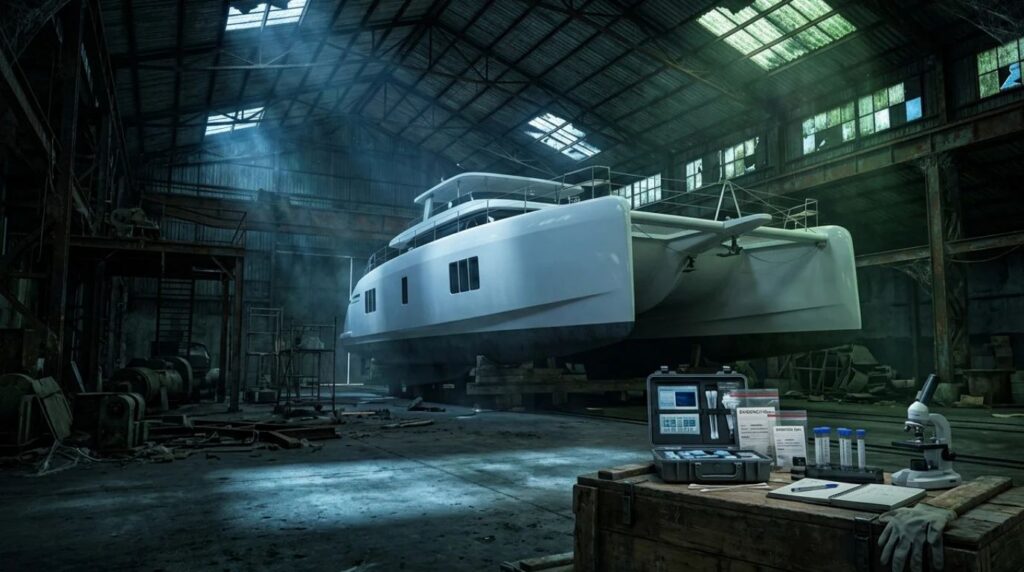
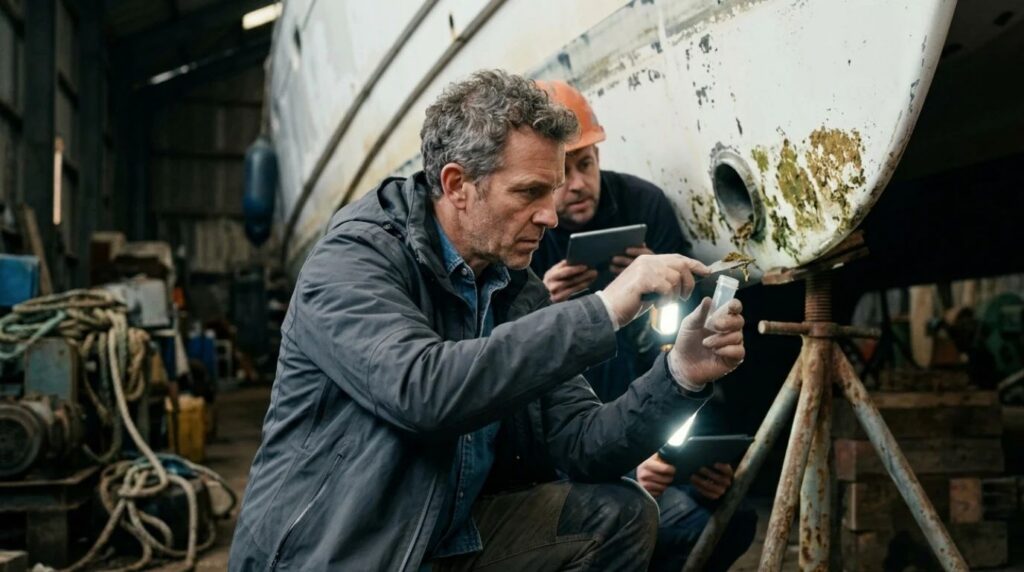
Acting on this digital lead, federal insurance investigators located *The Blue Horizon* hidden inside an abandoned, covered dry-dock facility in Georgia, repainted with a fraudulent identification number. To definitively prove that the vessel had not been sitting in dry dock for months as the facility records claimed, investigators deployed **Forensic Phycology**—the scientific analysis of algae growth. Marine biologists sampled the specific layers of diatomaceous algae adhered to the yacht’s hull intakes. The genetic profile and lifecycle metrics of the algae proved that the vessel had been actively operating in the warm, high-salinity currents of the Gulf Stream just days prior to the reported sinking. This cross-verification of digital data and physical evidence is a standard protective protocol across all lines of insurance; just as cyber investigators track digital trails during a personal cyber insurance homeowners fridge ransom case to trace network entry points, marine underwriters utilize environmental science to expose physical fraud.
g>Senior Maritime Forensic Investigator Insight: “The ocean leaves an indelible biological signature on everything it touches. A yacht owner can repaint a hull, forge registration documents, and delete digital transponder logs, but they cannot rewrite the growth cycle of Atlantic diatoms. The biology of the sea always tells the truth.”
Environmental Forensics and Maritime Moral Hazard
To fully comprehend how specialized marine analytics expose corporate scams, we must look at the academic data governing ocean tracking and behavioral science:
- The Science of Algae Succession: A research paper published in the Journal of Forensic Sciences outlines that marine bio-fouling acts as a highly accurate geographical and chronological clock, allowing scientists to determine exactly how long a structure has been submerged in specific oceanic coordinates based on species diversity.
- The Scarcity Bias in High-Value Asset Fraud: Economic research from the Maritime Policy & Management Journal establishes that as maintenance costs for luxury assets rise during economic recessions, owners experience a profound scarcity bias, leading them to view insurance fraud as a viable strategy to liquidate non-performing, illiquid luxury investments.
The Finality of Intentional Scuttling
How Does the System Work?
Under international maritime law and standard hull insurance contracts, the deliberate sinking or abandonment of a vessel by its owner is classified as **Scuttling**. Scuttling is a severe maritime crime that immediately triggers the **Concealment and Fraud Exclusion Clause**, rendering the entire policy completely void retroactively. The owner loses all rights to indemnity, and the carrier is legally entitled to recover all corporate resources spent on satellite tracking and marine biology experts.
Richard Sterling’s policy was canceled, his yacht was seized by federal authorities, and he was indicted on criminal charges of wire fraud and maritime barratry. This absolute legal forfeiture applies uniformly across all insurance sectors whenever an insured asset is deliberately compromised for financial gain. Whether a policyholder is concealing a million-dollar yacht in a secret drydock or fabricating physical evidence during a highly contested commercial auto insurance truck accident claim investigation, the systemic consequence remains unyielding: total loss of legal protection, complete financial ruin, and immediate prosecution.
Key Legal Clauses in Maritime Contracts:
- Perils of the Sea Coverage: Protects exclusively against accidental maritime hazards such as groundings, collisions, and unpredictable weather events.
- The Warranty of Utmost Good Faith (Uberrimae Fidei): A foundational maritime law principle requiring both parties to disclose absolute, uncompromised truths. Any violation completely destroys the contract’s legal validity.
Questions (FAQs)
1. Does boat insurance cover my yacht if it sinks in a hurricane?
Yes. Standard marine policies fully cover sudden sinking caused by verified weather events and hurricanes, provided the owner took documented, reasonable precautions to secure the vessel prior to the storm.
2. What is AIS tracking in a boat insurance claim investigation?
AIS stands for Automatic Identification System. It is a satellite tracking network that continuously records a vessel’s speed, course, and location. Insurance companies use it to reconstruct the exact timeline of a reported accident.
3. What happens if an insurance company proves a boat was deliberately abandoned?
The claim is immediately denied, the entire policy is permanently canceled, the owner faces felony criminal charges for insurance fraud, and they must personally pay for any environmental cleanup or salvage costs.
Conclusion
Navigating the open ocean requires not only expert seamanship but also absolute compliance with your legal insurance agreements. The biological exposure of the *The Blue Horizon* conspiracy serves as a definitive warning to the luxury market: satellite networks and environmental forensics have made asset deception entirely transparent. Attempting to escape personal financial liabilities by fabricating a deep-sea shipwreck is an absolute path to criminal prosecution and asset forfeiture. Protecting your marine investments through transparent record-keeping and legitimate risk management is the only way to safeguard your nautical passion and your personal freedom.