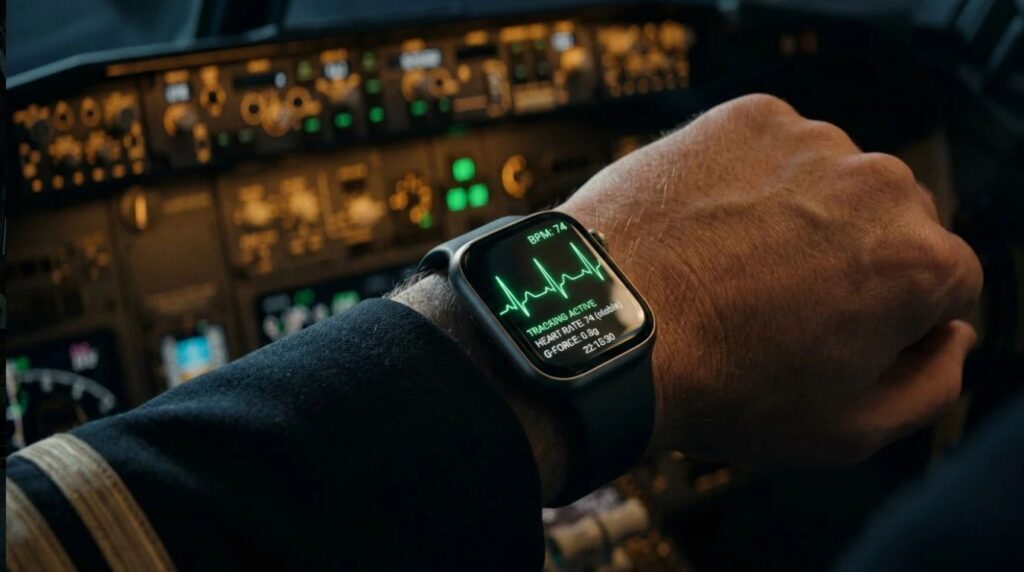
The Heart Rate Alibi: How Wearable Data Exposed Health Insurance Fraud
The intersection of biometric monitoring and corporate indemnity has created an advanced clinical frontline where claims underwriters no longer rely on subjective psychiatric evaluations to process premium payouts. Imagine a highly experienced commercial aviator claiming that a sudden, terrifying near-miss mid-air collision left him with permanent, incapacitating flight anxiety. For Captain David Vance, this mental health trauma meant an immediate end to his active flying career and a justification for a major corporate payout. However, specialized underwriters soon proved that evaluating complex health insurance fraud syndicates requires deeper technological tools, as what was presented as an incurable psychological injury was completely dismantled by the hidden digital data tracking his own heart.
The Narrative: The Timeline of a Fabricated Aviation Phobia
The financial deception began during a severe corporate audit of David Vance’s private logistics charter business. Faced with mounting operational debts and pending regulatory fines, Vance looked for a lucrative exit strategy that would protect his personal assets from corporate bankruptcy. Using his deep familiarity with aviation distress protocols, Vance filed an official report detailing a severe atmospheric turbulence incident during a solo cross-country flight, asserting that the aircraft nearly suffered structural failure. He claimed this single event triggered acute, treatment-resistant Post-Traumatic Stress Disorder (PTSD) and aviophobia, making it psychologically impossible for him to ever step inside a cockpit again.
To secure his multi-million dollar disability and medical retirement package, Vance perfectly executed his symptoms during independent psychiatric examinations, exhibiting manufactured hand tremors, elevated respiratory breathing rates, and reporting chronic insomnia. He believed that because psychological trauma cannot be verified via traditional X-rays or blood tests, the insurance company would have no choice but to validate his permanent impairment. For nearly a year, Vance lived a quiet, unmonitored lifestyle while collecting massive tax-free monthly corporate payouts, confident that his medical file was completely beyond corporate dispute.
Investigative Analysis: The Anatomy of a Wearable Digital Audit
Why Did the Psychological Deception Happen?
The fraud targeted a classic procedural vulnerability within medical and disability underwriting landscapes: the historical dependence on self-reported patient symptoms during psychiatric evaluations. Vance knew that if a patient consistently reports panic attacks, night terrors, and severe claustrophobia, clinical ethics prevent doctors from easily dismissing the condition as a lie without concrete, objective physiological evidence to the contrary.
The financial goal was to secure a guaranteed lifetime corporate income stream while secretly participating in high-thrill private recreational activities. Vance assumed that once his medical retirement was approved, the underwriters would close the file, allowing him to enjoy extreme sporting hobbies without further surveillance.
How Was the Fraud Investigated and Uncovered?
Specialized corporate medical adjusters did not just read Vance’s therapy logs; they secured a federal subpoena to access the complete historical data archives of his consumer smartwatch and fitness tracker via **Wearable Digital Forensics**. Cyber forensic analysts extracted the device’s raw accelerometer metrics, photoplethysmography (PPG) heart-rate sensors, and sleep-architecture telemetry logs covering the exact dates Vance claimed he was suffering from continuous panic attacks and chronic insomnia.
The biometric data provided undeniable physiological proof. During the precise hours Vance claimed he was experiencing waking nightmares and severe panic-induced tachycardia, his wearable device recorded a perfectly stable resting heart rate of 58 beats per minute and deep, undisturbed REM sleep patterns. The final investigative breakthrough occurred when data analysts cross-referenced his GPS smartwatch telemetry with regional recreational records. The data proved that on the exact afternoon Vance claimed he was too psychologically traumatized to approach an airfield, his heart rate spiked to 145 beats per minute during a voluntary, unrecorded high-altitude skydiving jump. This calculated integration of biometric data and technological tracking is a uniform requirement across complex insurance lines; just as investigators trace digital network entries during a personal cyber insurance homeowners fridge ransom case, medical underwriters deploy wearable biometrics to expose physical and psychological misrepresentation.
Director of Digital Biometric Forensics Insight: “A claimant can practice manipulating their facial expressions, breathing, and verbal responses for a two-hour doctor’s appointment. But they cannot force their autonomic nervous system to lie to a wearable biometric sensor for 24 hours a day. The digital pulse profile never commits perjury.”
Academic Perspectives: Autonomic Biometrics and Malingering Verification
To fully understand how modern biometric data refutes sophisticated psychological scams, we must look at the academic data governing human physiology:
- The Involuntary Nature of Heart Rate Variability (HRV): A clinical study published in the Journal of Psychophysiology demonstrates that genuine panic disorders and PTSD cause structural, measurable changes in autonomic nervous tone, altering involuntary Heart Rate Variability patterns in a way that cannot be simulated or suppressed by a conscious individual.
- The Integrity of Consumer Wearable Data in Litigation: Research from the Harvard Journal of Law & Technology establishes that continuous passive data collection from commercial wearable devices provides a highly reliable, legally admissible baseline of a patient’s true functional capacity, completely overriding subjective medical assessments in modern tort cases.
The Legal and Insurance Lesson: The Consequence of Fabricated Illness
How Does the System Work?
Under federal insurance regulations and healthcare contract laws, submitting falsified clinical statements or manipulating symptom reports to obtain financial benefits constitutes a severe material breach. The moment biometric evidence proves a deliberate misrepresentation of a physical or mental medical state, the insurer invokes the **Fraud and Concealment Provision**, completely terminating the policy retroactively and initiating immediate asset recovery actions to reclaim all previously distributed funds.
David Vance’s executive policy was canceled, his professional aviation licenses were permanently revoked by federal authorities for filing fraudulent medical reports, and he was indicted on criminal charges of major healthcare fraud and grand larceny. This total legal forfeiture is applied strictly across all lines of specialized underwriting when a contract is intentionally exploited. Whether a claimant is fabricating a severe psychological phobia or attempting to secure massive commercial assets through a staged commercial auto insurance truck accident claim investigation, the structural consequence remains unyielding: total loss of legal protection, complete financial ruin, and immediate prosecution.
Key Legal Definitions in Healthcare Protection:
- Objective Medical Evidence: Documented physiological data, laboratory metrics, or biometric tracking that independently confirms the presence of a limiting medical condition without relying solely on patient testimony.
- The Materiality Principle: Any statement or concealed data that directly influences an underwriter’s decision to accept a risk or pay a claim is legally deemed material, meaning any fraud tied to it completely invalidates the contract.
Questions (FAQs)
1. Can a health or disability insurance company legally demand my smartwatch data?
Yes. During a contested claim investigation, insurers have the legal right to request relevant digital data under the policy’s “Duty to Cooperate” clause. Refusing to provide the data can result in an immediate denial of the claim.
2. How does wearable digital forensics detect fake panic attacks?
Forensic systems analyze continuous data streams measuring heart rate, skin temperature, and motion. A real panic attack triggers immediate, involuntary physiological spikes, which will be completely absent if the symptom is being faked.
3. What happens if an insurance claim is denied due to material misrepresentation?
The policy is canceled, all current and future benefits are permanently lost, the insurance company can sue to recover investigation expenses, and the case is referred to law enforcement for criminal prosecution.
Conclusion
Protecting your health and maintaining your professional insurance agreements requires absolute transparency and rigorous compliance with objective medical tracking. The biometric breakdown of Captain Vance’s aviation phobia scheme delivers a definitive warning to modern consumers: advanced data processing and wearable analytics have made health deception entirely transparent. Attempting to exploit a premium policy contract by fabricating invisible mental health symptoms is an absolute path to criminal prosecution and professional ruin. Safeguarding your career through honest risk documentation and transparent **health insurance fraud** prevention standards is the only way to preserve your professional legacy and your personal freedom.