

The Indiana Inferno: How a Luxury Home Fire Became an Insurance Fraud Investigation
When Fire Became a Financial Escape Plan
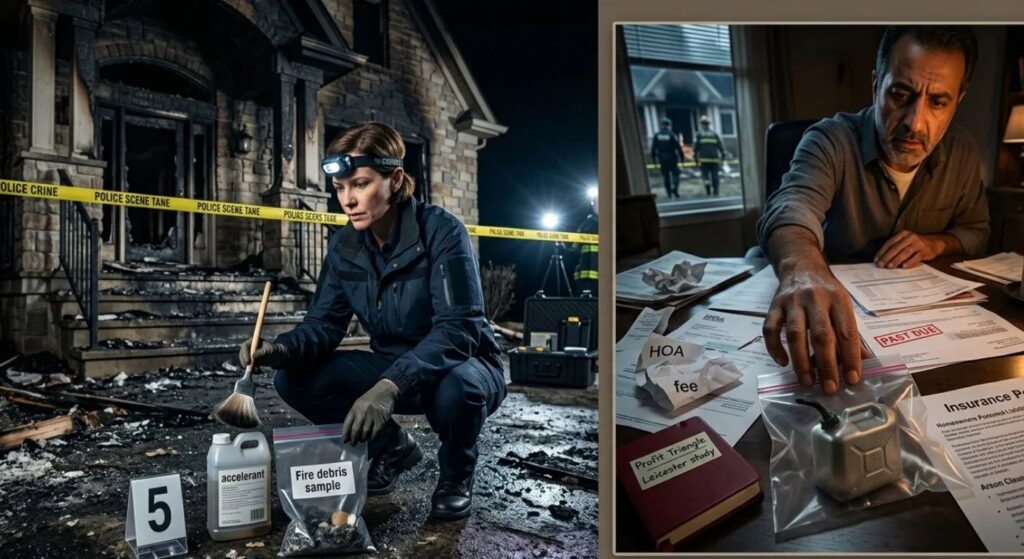
In the quiet suburbs of Indiana, a luxury villa was consumed by flames in minutes. While it appeared to be a tragic accident, this case became a textbook example of home insurance arson fraud, where financial pressure drives homeowners to desperate measures.
The homeowner, a struggling businessman facing mounting financial pressure, claimed the disaster started because of an accidental electrical malfunction while he was away from the property.
At first glance, the tragedy appeared to be exactly what homeowners insurance was designed for: a devastating and unexpected loss.
But investigators would later discover something far darker hidden beneath the ashes.
The fire was not the homeowner’s enemy — it was allegedly his final financial strategy.
Investigative Breakdown: Reconstructing the Financial Crime
In major home insurance fraud investigations, forensic experts do not simply analyze flames. They reconstruct behavior, timelines, financial stress, and physical evidence.
This case quickly evolved into what investigators call an “economic arson investigation.”
Why the Fraud Allegedly Happened
According to investigators and insurance analysts, the homeowner was not viewed as a career criminal, but as someone trapped under severe economic pressure.
- Mortgage payments were reportedly overdue
- Investment losses had intensified financial instability
- The luxury property had become difficult to sell
- Debt obligations were growing faster than income
Investigators believed the homeowner viewed the insurance policy as a faster and more reliable financial exit than the collapsing real estate market itself.
How Insurance Investigators Detected the Fraud
The insurance company deployed specialized Origin and Cause Investigators trained in forensic fire reconstruction.
Their findings reportedly revealed multiple “red flags” inconsistent with an accidental electrical fire:
- Accelerant Traces: Laboratory testing detected gasoline residues in multiple unrelated areas of the property.
- Multiple Ignition Points: Fire behavior suggested the blaze began in several locations simultaneously.
- Abnormal Burn Patterns: Investigators identified irregular “pour patterns” often associated with intentionally spread accelerants.
- Missing Valuables: Jewelry, family photographs, financial documents, and portable luxury items had allegedly been removed before the fire.
Investigators also reconstructed the first minutes of the fire using heat progression analysis and computer-based fire modeling.
According to forensic specialists, the fire spread far too aggressively and uniformly to match the behavior of a standard electrical malfunction.
The Digital Evidence Trail
Modern insurance fraud investigations rely heavily on Big Data analytics and digital reconstruction.
Phone records reportedly showed that the homeowner had communicated repeatedly with a contractor known to investigators shortly before the incident occurred.
Financial records also revealed unusual activity:
- Large overdue debts
- Loan restructuring attempts
- Insurance coverage reviews shortly before the fire
Investigators later examined whether the policyholder attempted to inflate the insurance claim itself through:
- Exaggerated inventory lists
- Overstated luxury possessions
- Inflated reconstruction estimates
- Expanded temporary living expense claims
Similar insurance disputes involving property damage investigations can also be seen in this internal case study: Homeowners Insurance Claim Mold & Water Damage Case .
Insurance Expert Insight: The Psychology Behind Arson Fraud
Insurance experts often explain that homeowners insurance fraud is not always driven by greed alone.
In many cases, it emerges from what criminologists describe as “financial survival psychology.”
Fraud investigators frequently apply the Fraud Triangle Theory:
- Pressure: Severe financial distress and debt
- Opportunity: High insurance coverage and isolated property conditions
- Rationalization: The belief that “I paid premiums for years, so I deserve the payout.”
According to behavioral research, many policyholders psychologically redefine insurance fraud as a “financial correction” rather than a criminal act.
Analysis
Research from the Coalition Against Insurance Fraud and environmental criminology studies shows that insurance fraud rates often rise during economic downturns and housing market instability.
Psychological studies from the University of Leicester suggest that many fraud offenders experience a form of moral disengagement, where they no longer perceive insurance companies as real victims.
Technically, modern fire investigations now use:
- Thermal pattern analysis
- Computer fire simulations
- Chemical residue testing
- Electrical arc mapping
- 3D forensic reconstruction
These technologies allow investigators to distinguish accidental fires from intentionally accelerated fires with increasing precision.
Another famous example of insurance-related property investigation failures and disputes can be explored here: The Hurricane Katrina Insurance Scandal .
How the Insurance System Responds
In the United States, intentional insurance fraud involving arson is classified as a felony offense.
Once intentional destruction is proven:
- The insurance policy may become completely void
- The insurer can deny the entire homeowners insurance claim
- Criminal prosecution may begin immediately
Courts can also order:
- Restitution payments
- Repayment of investigative expenses
- Prison sentences
- Permanent fraud database reporting through ISO ClaimSearch
Being listed in national fraud databases can make future insurance approval, mortgage applications, and business financing extremely difficult.
FAQ:
Q: Do insurance companies investigate all house fires?
No. Most homeowners insurance claims are processed normally. However, investigations intensify when adjusters identify “red flags” such as financial distress, unusual burn patterns, or inconsistent statements.
Q: Can homeowners insurance deny a fire claim?
Yes. If investigators believe the fire was intentionally set or that material misrepresentation occurred during the claim process, insurers can legally deny coverage.
Q: What evidence do fire investigators look for?
Investigators analyze burn patterns, accelerants, electrical systems, witness statements, surveillance footage, financial records, and chemical residues.
Q: Does homeowners insurance cover accidental fires?
Yes. Most policies cover accidental fires caused by cooking accidents, candles, electrical failures, or negligence — but not intentional acts.
Q: Can gasoline residue prove arson?
Gasoline residue alone may not prove guilt, but it is considered a major indicator when combined with suspicious fire behavior and financial evidence.
The Fire That Burned More Than a House
The Indiana fire case ultimately ended with prison time, financial collapse, and permanent reputational damage for the homeowner.
The lesson is brutally simple:
Insurance is a safety system for genuine disasters — not a financial escape hatch during economic desperation.
In modern America, fire investigators, insurance companies, and forensic analysts no longer rely on instinct alone.
They rely on data, chemistry, digital evidence, behavioral science, and forensic reconstruction.
And eventually, the truth hidden beneath the ashes almost always resurfaces.
Sources & References

Pingback: Personal Cyber Insurance for Homeowners: The Smart Fridge Ransom
Pingback: Identity Theft Insurance Coverage: The $80K Senior Scam
Pingback: Disability Insurance Fraud: The Blind Pilot Deception