
Luxury Auto Insurance: How Airbag Control Modules Verify Vehicle Crash Claims
Evaluating physical damage claims involving high-performance sports cars requires a precise technical review of onboard crash data and mechanical impact marks. When a policyholder reports a severe single-vehicle accident in a remote area, insurance adjusters must investigate the physical forces involved to confirm the sequence of events. Processing a luxury auto insurance claim for a totaled vehicle has become a highly scientific process today, as modern vehicle event data recorders (EDRs) and airbag deployment logs provide objective digital evidence regarding the exact velocity, engine status, and brake usage during an impact.
Reported Single-Vehicle Mountain Accident
The owner of an expensive European sports car was facing high monthly lease payments and a steep decline in his personal investment portfolio. To eliminate the financial burden of the vehicle, he decided to simulate a total-loss accident to collect an $85,000 insurance payout under his comprehensive auto coverage.
The owner drove the vehicle to an unmonitored dirt road in a mountainous region. Instead of risking a physical injury by crashing the car at high speed, he parked the vehicle safely next to a large boulder and turned off the engine. Using a heavy industrial sledgehammer, he struck the front bumper and the specific chassis points where the impact sensors are located multiple times. The repeated mechanical force triggered the vehicle’s safety system, causing the front airbags to deploy. He then called for a tow truck and filed an official report stating that he lost control of the vehicle due to sudden wet road conditions and struck the boulder at 40 miles per hour.
Reviewing the Airbag Black Box Data
Why Was the Crash Claim Audited?
The insurance adjuster noted several structural anomalies during the physical inspection at the salvage yard. While the front airbags had fully deployed, the vehicle’s aluminum rims, tires, and undercarriage showed zero structural damage, which is highly unusual for a 40-mph impact against a solid rock. Additionally, the localized dent marks on the front bumper frame displayed distinct geometric shapes consistent with repeated tool impacts rather than an organic vehicular collision.
The policyholder assumed that because the airbags had deployed and the front bodywork was severely crushed, the insurance company would automatically classify the car as a total loss and write a check without investigating the electronic control units inside the dashboard.
How Was the Fraud Discovered?
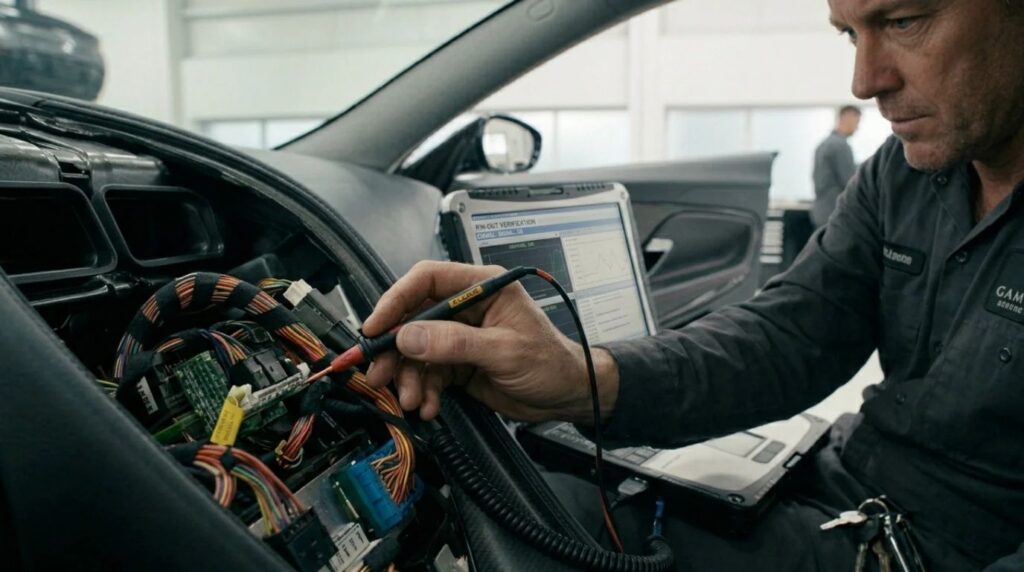
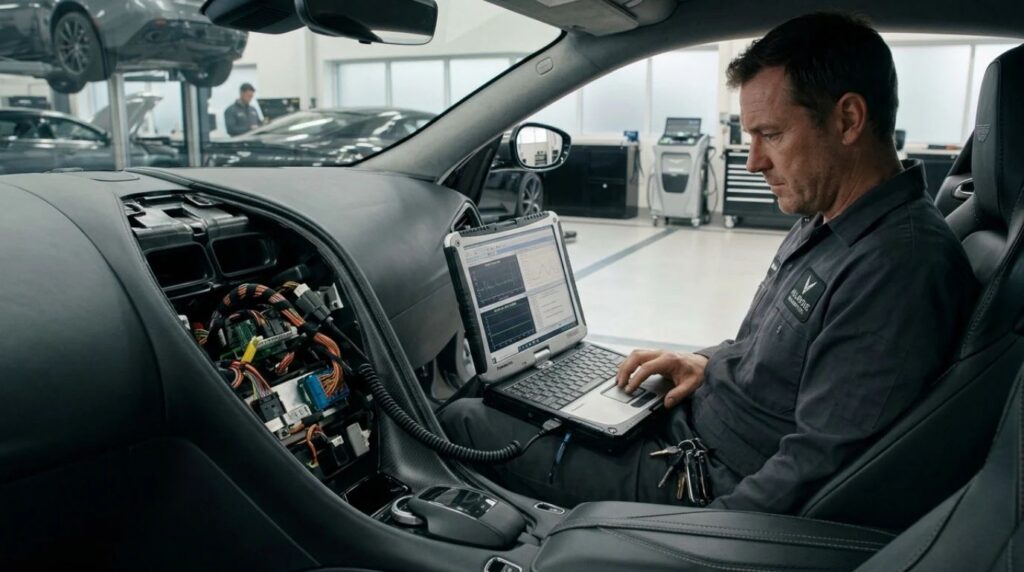
The insurance company’s automotive forensic team connected a specialized diagnostic interface to the vehicle’s **Airbag Control Module (ACM)**, often referred to as the automotive black box or Event Data Recorder (EDR). The ACM continuously monitors vehicle speed, throttle position, brake status, and seatbelt usage parameters in the seconds leading up to an airbag deployment command.
The downloaded digital report provided clear technical evidence that refuted the owner’s story. The EDR data logs proved that at the exact millisecond the deployment command was triggered, the vehicle’s speed was registered at 0 miles per hour, the engine RPM was at zero, and the ignition was completely turned off. The system also recorded that no seatbelts were buckled at the time of the event. This technical verification of vehicle data is a standard operational procedure; just as home underwriters review smart system records during a homeowners property insurance claim investigation involving electrical surge data, auto adjusters use electronic crash logs to confirm accident dynamics.
Automotive Forensic Engineer Insight: “Onboard computers record crash metrics down to the millisecond. When an airbag deployment file shows a vehicle was traveling at zero miles per hour with the engine turned off, it proves mathematically that the impact was simulated while the car was completely stationary.”
EDR Data and Impact Dynamics
Analyzing high-value vehicle losses requires an understanding of automotive telemetry and consumer behavioral risks:
- The Admissibility of ACM Forensic Logs: Research published in the SAE International Journal of Transportation Safety confirms that Event Data Recorder logs are highly accurate and legally binding in civil courts, as the data is written directly to non-volatile memory at the exact moment of sensor activation.
- Vehicle Liquidation Trends in Luxury Segments: A financial study from the Journal of Automotive Economics indicates that fraudulent luxury auto claims rise during economic corrections, as buyers attempt to exit high-interest financing contracts through vehicle total-loss fabrications.
Policy Rescission and Criminal Consequences
How Does the System Apply?
Auto insurance policies are governed by strict legal provisions regarding honesty and material representation. Under the **Concealment and Fraud Exclusion Clause**, providing false technical data or intentionally causing physical damage to a covered vehicle immediately invalidates the entire insurance contract. The carrier is legally entitled to reject the claim, cancel all coverage, and file a civil suit to recover forensic engineering costs.
The luxury vehicle owner’s claim was formally denied, his auto policy was canceled, and the vehicle was seized as evidence. The insurer forwarded the forensic report to local law enforcement, leading to the owner’s arrest for hard-core insurance fraud and grand larceny. This legal framework is applied consistently across all lines of insurance when misrepresentation is discovered. Whether an individual is fabricating vehicle crash metrics or staging an equipment loss during a commercial liability insurance investigation using GPS telematics tracking, the outcome remains unchanged: immediate claim rejection, loss of active coverage, and criminal prosecution.
Key Terms to Know in Premium Vehicle Insurance:
- Event Data Recorder (EDR): An onboard electronic device that captures technical data regarding vehicle speed, braking, and safety system status during a crash event.
- Comprehensive Coverage: Protects against damage to your car caused by non-collision events like fire, theft, vandalism, or extreme weather, requiring honest reporting of the cause of loss.
Questions (FAQs)
1. Do insurance companies check the vehicle’s black box for every car accident?
No. Insurers typically download EDR and black box data during major accidents involving high-value luxury cars, total losses, or when there are clear physical contradictions between the driver’s statement and the damage on the vehicle.
2. Can an insurance company deny a claim if the vehicle’s EDR is physically damaged?
The EDR module is heavily protected inside the vehicle’s chassis and rarely suffers complete data destruction. If the module is missing or intentionally tampered with, the insurer can delay or deny the claim based on a breach of the cooperation clause.
3. What happens to a vehicle’s insurance history after a fraudulent claim is detected?
The vehicle’s identification number (VIN) and the owner’s name are permanently flagged in national insurance databases like CLUE. This makes it extremely difficult or expensive for the individual to obtain auto insurance in the future.
Conclusion
Owning a high-performance luxury vehicle involves significant financial responsibility and strict compliance with your automotive insurance contract. The electronic crash metrics analyzed in this airbag module case demonstrate that modern vehicle electronics make faking a moving accident practically impossible to achieve. Attempting to solve personal debt problems by manually damaging a vehicle leads directly to policy cancellation and severe legal penalties. Maintaining accurate records and relying on transparent luxury auto insurance practices is the only effective way to protect your automotive investments and your personal record.


Pingback: Luxury Auto Insurance: Airbag Control Module Case Study
Pingback: Aviation Property Insurance: Commercial Drone Cloud Case Study